
P-80 and P-82 Set for Brazil as Chinese Yards Deepen Role in Petrobras FPSO Series
P-80 and P-82 will leave Singapore for Brazil in close succession, highlighting Seatrium's series-delivery model and the growing role of Chinese yards in hull, accommodation and critical-module packages.
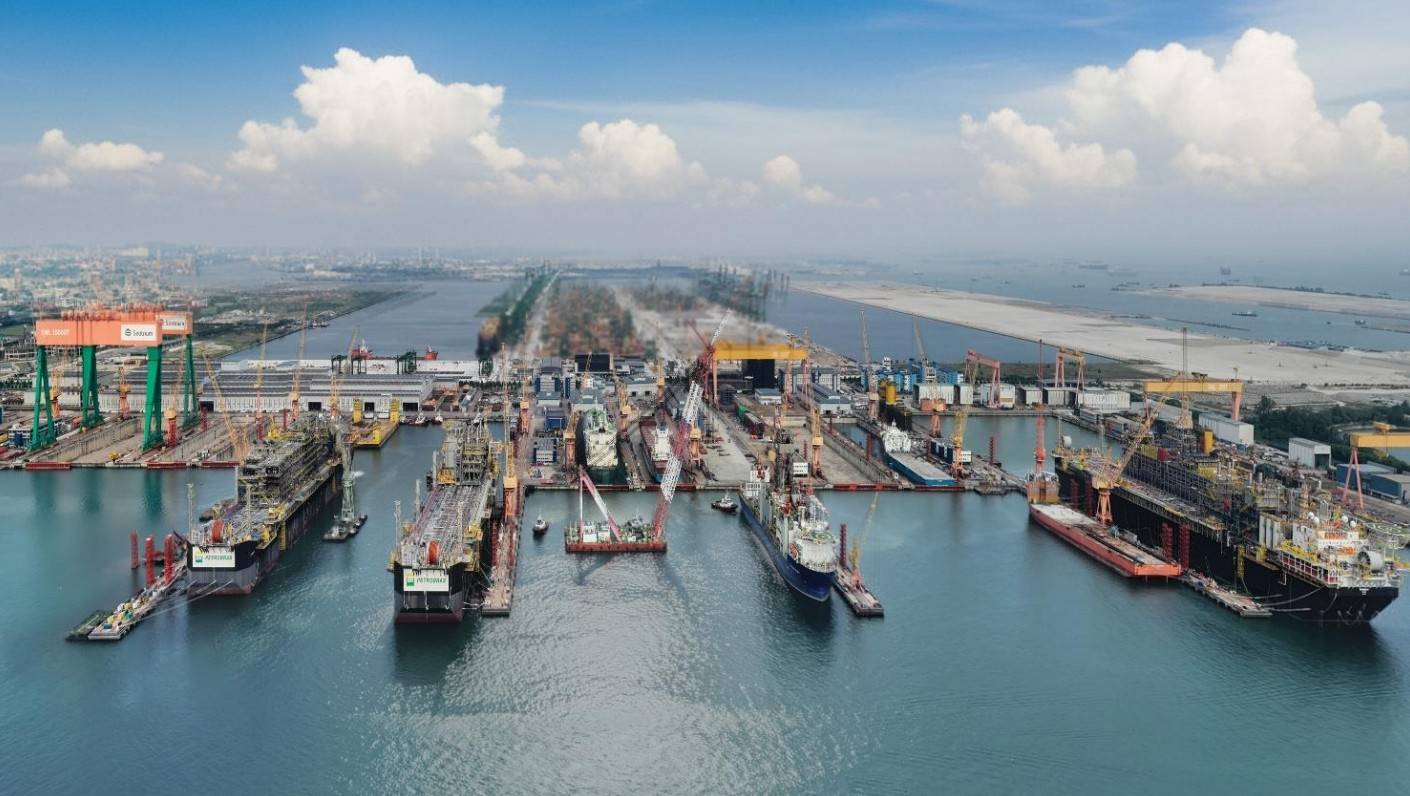
On August 27, Seatrium and Brazil’s Petrobras held a christening ceremony in Singapore for the P-80 and P-82 floating production, storage and offloading vessels. The two FPSOs are scheduled to leave Seatrium’s Tuas Boulevard Yard in close succession over the coming weeks before sailing to the Búzios field in Brazil’s pre-salt Santos Basin.
This does not mean that both vessels will depart on the same day. Seatrium describes the milestone as the industry’s first dual FPSO sailaway of this scale and complexity. P-80 and P-82 are the 47th and 48th projects undertaken by Seatrium for Petrobras, and the second and third turnkey FPSOs being executed under the P-Series model after P-78.
P-80 and P-82 will serve as the ninth and tenth production systems at Búzios. Each vessel is designed to produce 225,000 barrels of oil per day, process 12 million cubic metres of gas per day and inject approximately 250,000 barrels of water per day. Together, they will add 450,000 barrels per day of oil-production capacity. According to Seatrium, that represents an increase of approximately 34% in the field’s installed production capacity.
Sailaway from Singapore will not mark final project completion. After arriving in Brazil, the vessels will still undergo mooring, offshore commissioning and well connection activities. Petrobras confirmed in its second-quarter 2026 results that P-80, P-82 and P-83 are scheduled to start production in 2027.
A six-vessel P-Series delivery programme
P-80 and P-82 form part of a relationship between Seatrium and Petrobras that spans more than three decades. The current six-vessel P-Series newbuild programme comprises P-78, P-80, P-82, P-83, P-84 and P-85.
P-78 achieved first oil at the end of 2025 and is operating at Búzios. P-80, P-82 and P-83 will also be deployed at the field. P-84 and P-85 are intended for the Atapu and Sépia fields, with start-up currently planned for 2029 and 2030, respectively.
The programme is more than a sequence of six individual construction jobs. Petrobras is using high-capacity units, repeat designs and batch procurement to carry engineering, procurement and supply-chain experience from one project to the next. For Seatrium, the concurrent and consecutive execution of six multi-year projects creates opportunities to apply lessons from design, fabrication, integration and commissioning across the series.
The planned back-to-back sailaways of P-80 and P-82 are a visible demonstration of that model. Integrating and commissioning two large FPSOs in parallel at the same yard requires extensive coordination across shipyards, suppliers and project teams.
Chinese yards supplied hulls, living quarters and critical modules
P-80 and P-82 cannot accurately be described as either solely Chinese-built or Singapore-built. They reflect a global execution model in which Seatrium leads overall EPC delivery and final integration in Singapore, while yards in China, Brazil and Singapore fabricate hulls, living quarters, topside modules and supporting facilities.
CIMC Raffles was responsible for the hull and living-quarters packages for P-80 and P-83. The main hull of P-82 was built by COSCO Shipping Offshore Engineering in Qidong, with ZPMC’s Qidong Offshore Engineering yard participating in fabrication of the bow mega-block. CIMC Raffles also undertook the P-82 E-House module. Other P-Series modules were fabricated in China before being transported to Singapore for integration.
Chinese participation is continuing into the next phase. CIMC Raffles has secured EPC contracts covering the hulls, living quarters and M15B modules for P-84 and P-85, while Seatrium’s facilities in China, Singapore and Brazil will fabricate the remaining modules.
The imminent sailaways of P-80 and P-82 demonstrate Seatrium’s ability to orchestrate complex FPSO delivery across multiple countries. For China’s offshore sector, the more important point is that domestic yards are no longer contributing only isolated blocks. They are repeatedly securing hull, accommodation and critical-module packages across a series of Petrobras projects. That continuity—and the capability built through repeat delivery—is the real significance of China’s participation.