
Long-Idle Guohai Taixing Semisubmersible Reactivated for COSL
The long-idle cylindrical-hull Guohai Taixing semisubmersible has completed reactivation, certification and adaptation work and has been handed over to COSL for CNOOC's deepwater activities.
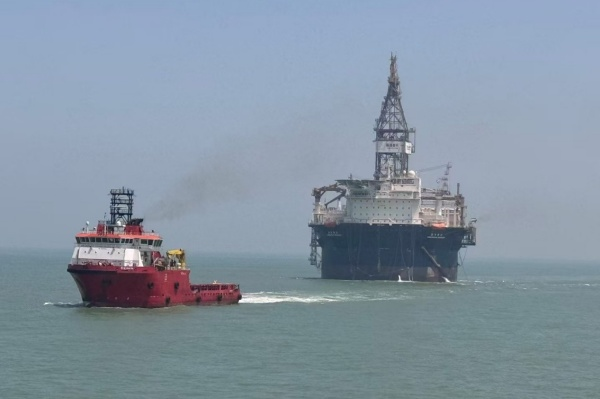
On 16 November, the Guohai Taixing (N419) deepwater semisubmersible drilling rig was handed over at China Merchants Industry’s Weihai yard. The yard, owner and rig manager jointly signed the handover certificate, completing an approximately eight-month programme of reactivation, certification and adaptation work. The rig was formally transferred to China Oilfield Services Limited and will support CNOOC’s deepwater exploration and development activities.
According to the handover announcement, Guohai Taixing is a sixth-generation ultra-deepwater dynamically positioned drilling rig. It has DP3 capability, a maximum operating water depth of 3,000 metres and a drilling depth of up to 10,000 metres.
The rig’s construction history dates back to the COSCO Offshore era. Guohai’s official product information identifies Guohai Taixing as the former Sevan Developer, a cylindrical-hull unit built by COSCO Qidong Offshore for a project company under Sevan Drilling. A 2016 announcement by COSCO’s Singapore-listed company put the original engineering, procurement and construction contract at US$526 million. The work undertaken at the Weihai yard was the reactivation and modification of an existing rig.
Sevan Developer went through several delivery deferrals. The parties reached an initial deferral agreement in 2014 and subsequently exercised a series of extension options. In October 2016, delivery was extended again to April 2017; in July 2017, the delivery period was further deferred to 30 June 2020. Seadrill said in its 2017 annual report that the rig would remain at the Chinese yard while Sevan continued to seek a suitable drilling contract and the financing needed to take delivery.
The disclosures at the time show how the drilling contract, financing and delivery arrangements became interdependent, leaving a heavily invested asset without delivery for years. Guohai Taixing was still being moved for maintenance in 2024: in August that year, it was towed from the COSCO yard in Qidong to Shanghai Shipyard on Chongming Island for maintenance.
Oceanwide Insight previously examined the prospects for such stranded assets in “Is a New Dawn Emerging for the Offshore Rig Market?” A recovery in selected drilling demand has created opportunities to complete, reactivate and modify existing rigs, but whether an individual unit can return to the market still depends on its condition, restoration cost and intended deployment. For shipyards and equipment suppliers, this work has become a source of business alongside newbuild projects.
The Guohai Taixing programme was organised around CNOOC’s deepwater equipment requirements and began on 20 March 2026. Guohai assembled a 23-member professional team combining core personnel with external resources and coordinated the yard, COSL, equipment suppliers and the classification society through construction, inspection and operational preparation.
The rig departed for Weihai on the evening of 20 May. After a six-day tow covering 527 nautical miles, it arrived at the China Merchants Weihai yard on 26 May, where equipment reactivation, system commissioning, inspection and certification continued.
Adaptation work proceeded in parallel with reactivation and certification. A procurement plan published in August 2026 covered accommodation modifications, equipment installation and repair, structural accessories and piping changes, protective works, DNV surveys and drawing revisions, together with yard berth and drydock services. The scope addressed both the restoration of equipment after prolonged lay-up and modifications required for the rig’s subsequent use.
Guohai organised the project, and the company’s establishment was itself tied to offshore assets left stranded by the previous market downturn. Founded in 2019, Guohai was tasked with the centralised disposal of offshore equipment held by Chinese central state-owned enterprises. It consolidated relevant assets and operated or disposed of them through leasing and market-based transfers.
Guohai’s management arrangements changed in 2024. In November, CNOOC decided to integrate Guohai with CNOOC International Financial Leasing and CNOOC Investment Holdings under one management team operating three corporate entities. On 31 December, China Chengtong and CNOOC signed a transfer memorandum and agreements delegating shareholder and board voting rights. Guohai was formally transferred to CNOOC, which assumed full responsibility for its management and operations. Following the rig handover, Guohai’s role will continue through operational management and follow-on support.