
Kongsberg Wins Wisting FPSO Systems Contract as Four-Year Pause Ends
Kongsberg Maritime will first support FEED for the Wisting FPSO safety and automation system, while the broader execution scope and fabrication awards remain conditional on concept selection, permits and a late-2027 FID.
Kongsberg Maritime said on 6 November that Equinor had awarded it a contract for the safety and automation system on the Wisting FPSO. Wisting is one of the largest undeveloped oil discoveries on the Norwegian continental shelf, and the contract is the latest development since design work on the project restarted.
During the initial project phase, Kongsberg Maritime will support front-end engineering and design for the safety and automation system, working with Equinor and other suppliers to develop the FPSO concept. If the project moves into execution, its scope would expand to process control, safety systems, digital infrastructure, cybersecurity and related services. Kongsberg Maritime did not disclose the contract value or a delivery schedule.
A major undeveloped Barents Sea oil discovery
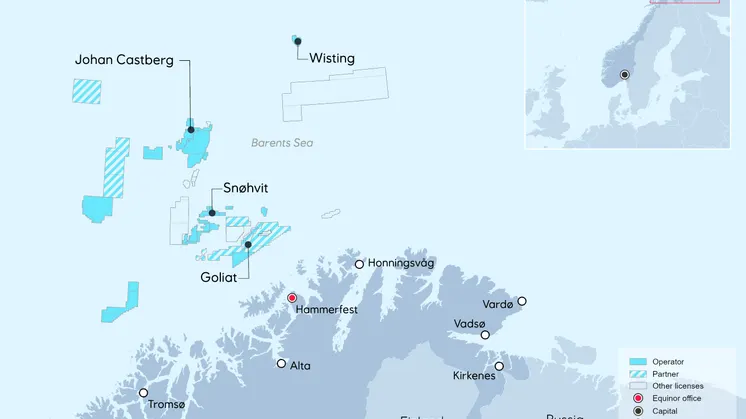
Wisting lies in the Norwegian Barents Sea in water depths of about 390 to 418 metres. Discovered by OMV in 2013, it has estimated recoverable resources of close to 500 million barrels of oil equivalent and is one of the largest undeveloped oil discoveries on the Norwegian continental shelf.
Equinor is the operator with a 42.5% interest. Aker BP holds 27.5%, Petoro 20% and INPEX Idemitsu Norge 10%. The field is expected to operate for about 30 years.
Equinor listed Wisting among its pre-final-investment-decision projects in its 2026 capital markets material, with expected total production capacity of 125,000 to 140,000 barrels of oil equivalent per day. With no nearby production facility available for a tie-back, Wisting is planned as a standalone FPSO development supported by a subsea production system.
A cylindrical FPSO concept was selected in 2021
Wisting had already entered front-end design in 2021. At that time, Equinor selected a cylindrical FPSO based on the Sevan design and planned to supply the offshore facility with power from the Norwegian mainland through a long-distance subsea cable.
Aker Solutions received an FPSO FEED contract worth about NOK 350 million, covering the overall solution for the topsides, living quarters and hull. The contract also included an EPCI option estimated at NOK 8 billion to NOK 12 billion, which was intended to proceed after project approval.
By 2022, however, the estimated investment had risen to about NOK 104 billion. Inflation, constrained supplier capacity and higher project costs led Equinor and its partners to postpone the investment decision that had been planned for the end of that year.
Power from shore dropped as front-end design restarts
Equinor restarted the Wisting environmental impact assessment process in June 2026. The most visible change from the previous concept is the removal of power from shore.
Equinor said the long-distance power-from-shore solution was technically complex and costly. The new concept will instead use efficient gas turbines as the FPSO’s main source of power. The project will also study the feasibility of capturing carbon dioxide on the production facility and storing it beneath the seabed. Whether CCS remains in the concept will depend on technical conditions, regulatory requirements and overall economics.
Supplier work has restarted as well. In October, Equinor awarded Aibel the FEED contract for the FPSO topsides, with about 250 people expected to take part in the design work. The contract also includes options for later engineering, procurement and project-management support, while topsides fabrication contracts will be awarded separately.
Kongsberg Maritime’s safety and automation work will proceed alongside Aibel’s topsides design, providing a technical basis for later investment and execution decisions.
Equinor has so far confirmed only that Wisting will use a newbuild FPSO. The concept illustration released with Aibel’s latest FEED award shows a ship-shaped FPSO, but the design is still being matured during front-end engineering.
Equinor has also said that the Wisting FPSO hull cannot be built in Norway because of its size and yard-infrastructure requirements, while Norwegian suppliers will first be able to compete for topsides work. The hull strategy, yard selection and module split will therefore be important issues in the project’s next phase.
Final investment decision planned for late 2027
The Wisting partners plan to select the final development concept and decide whether to continue at the end of 2026, followed by a final investment decision in late 2027.
The topsides, safety and automation design work now under way, together with the gas-turbine and CCS studies, will determine whether this large Barents Sea development can meet Equinor’s cost and return requirements. Contracts for the hull, topsides, subsea production system and related equipment will move into execution only if the project passes the investment decision.