
Mengxiang Completes South China Sea Trial Drilling, Reaching 5,000-Metre-Class Coring Capability
Mengxiang drilled and cored two wells in about 4,100 metres of water, reached a maximum completed depth of 4,929.17 metres and recovered 4.27 metres of ocean-basin basalt core.
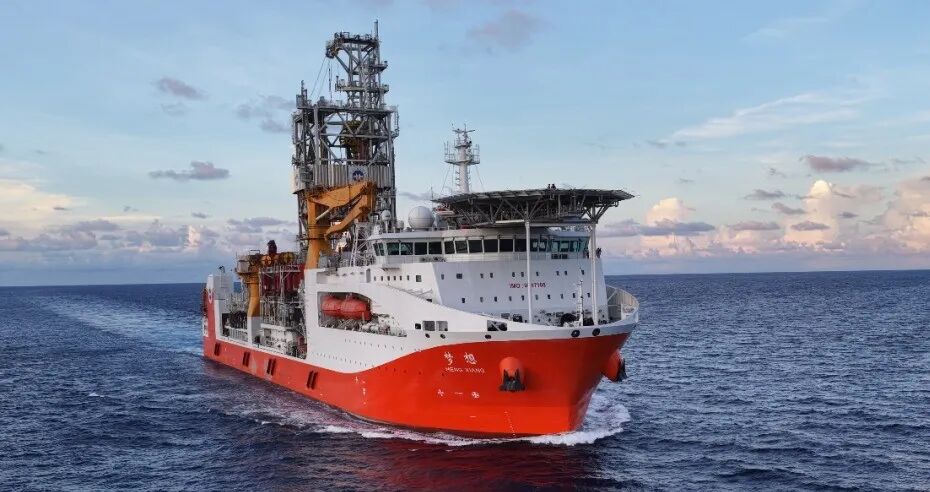
China’s first domestically developed ocean drilling vessel, Mengxiang, has completed a 30-day trial drilling campaign in the South China Sea and returned to Guangzhou, the China Geological Survey said on 28 September. The vessel drilled and cored two wells in water depths of about 4,100 metres, demonstrating a full-cycle capability for ultra-deepwater scientific ocean drilling.
The campaign reached a maximum completed depth of 4,929.17 metres and a maximum penetration of 864.77 metres, setting a new Chinese record for independently conducted drilling at water depth. Using a domestically developed rotary coring tool, the team recovered 4.27 metres of basalt core from the South China Sea ocean basin. According to the China Geological Survey, this made China the third country, after the United States and Japan, to recover hard-rock samples from a deep-ocean basin with a drilling vessel.
The programme also tested the vessel’s deepwater support systems. Two remotely operated vehicles accumulated more than 358 hours of work at 4,000 metres, including a longest continuous deployment of 103 hours. Scientists completed core acquisition, logging, splitting, scanning, sampling, testing and storage on board in line with international ocean-drilling procedures, while recovery exceeded 100% on several coring runs.
Initial analysis provides new evidence on the South China Sea’s tectonic and environmental history. The team identified multiple phases of large-scale volcanic activity after a shift in the spreading ridge. It also encountered alternating red and green-to-dark-green pelagic sediments, as well as several tens of metres of interbedded sand and mud between 813 and 864 metres below the seabed. The interval shows clear bioturbation and is rich in organic matter.
The samples and data will support further research into the formation and evolution of the South China Sea, palaeoenvironmental change and ultra-deepwater energy resources. The expedition was organised by the China Geological Survey and implemented by the Guangzhou Marine Geological Survey, with 170 participants from nine organisations, including COSL, Peking University and China State Shipbuilding Corporation.
The trial was Mengxiang‘s first systematic scientific ocean-drilling campaign since entering service. The stated 5,000-metre-class milestone refers to the vessel’s integrated deepwater drilling and coring capability; the voyage validated drilling, coring, ROV coordination and onboard sample-processing systems through a maximum completed depth close to 5,000 metres and penetration of 864.77 metres.