
From Welding to Shipbuilding Intelligence: Robots Move Deeper into the Yard
Shipyard welding automation is moving from fixed stations into blocks, sensing and production scheduling. Its value depends on yield, utilisation, changeover time and integration with surrounding processes.
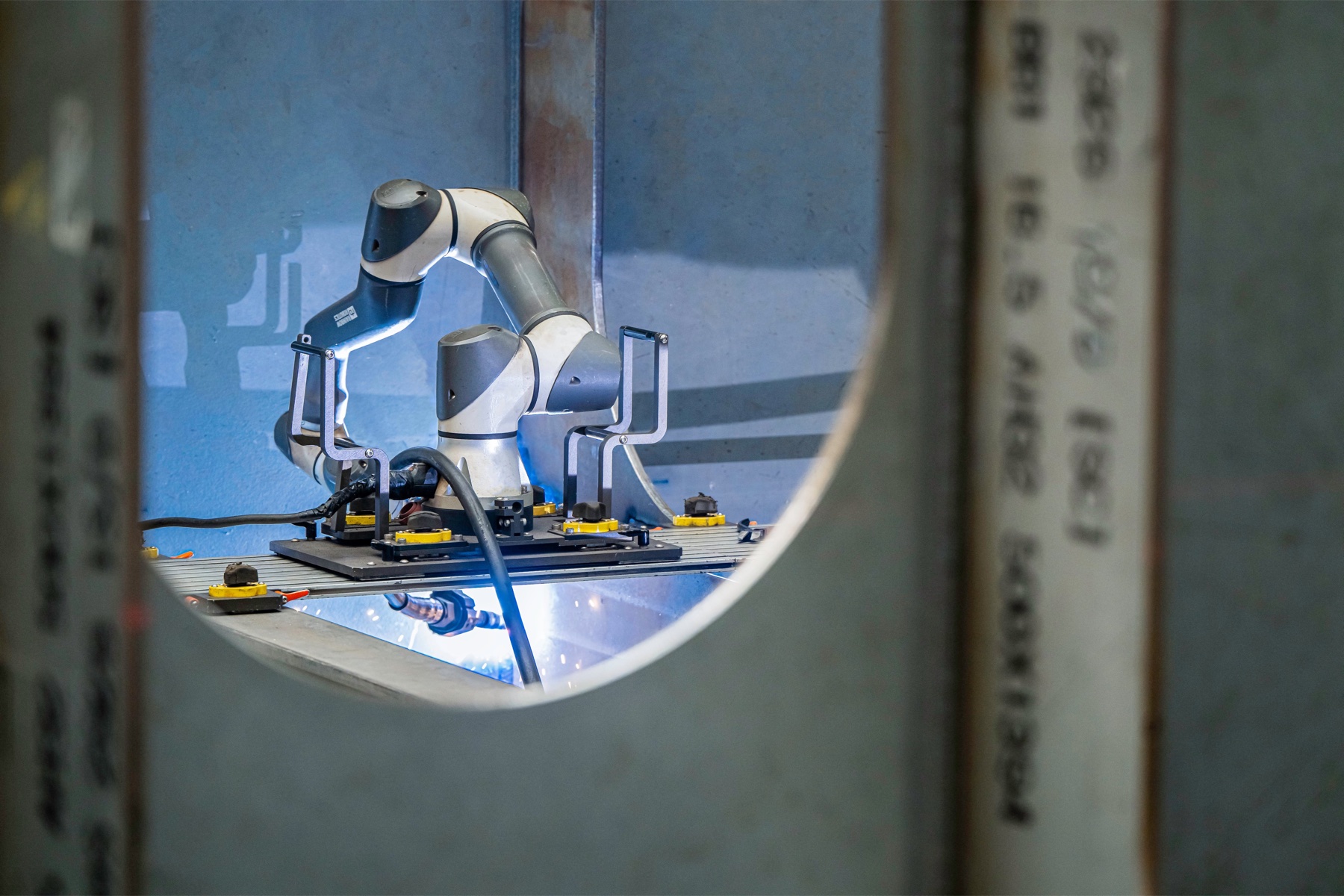
In a shipyard, a vessel begins as steel plate. Cutting, welding and assembly turn that plate into components, blocks and eventually a hull in the dock. Welding runs through almost the entire construction process, but the working conditions vary sharply: some seams are straight and accessible inside a well-equipped shop, others lie inside confined blocks, and erection welds move as construction progresses.
That is why shipbuilding automation will not be solved by one universal robot. Fixed lines, lightweight collaborative units, rail-mounted and mobile platforms, vision systems and humanoid experiments address different parts, spaces and production models. The question is moving beyond whether a robot can weld at all to whether it can repeatedly deliver acceptable welds under real shipyard conditions.
Order growth puts welding capacity under pressure
China’s Ministry of Industry and Information Technology said the country accounted for 63.6% of global shipbuilding completions, 81.8% of new orders and 72.4% of backlog by deadweight tonnage in the first three quarters of 2026. A strong orderbook requires yards to sustain high production for years. Welding is central to that effort, but it depends on skilled labour and often takes place amid heat, fumes, spatter and confined spaces.
At a stable workstation, a robot can repeat programmed paths and parameters, reducing physical exposure and helping maintain consistency. Shipbuilding, however, is not automotive-style mass production. Parts differ in size and geometry, steel deforms during cutting, fit-up and welding, and actual joint positions or gaps may depart from the digital model.
Conventional robots rely heavily on teaching. A new part or a changed workstation can require fresh programming and adjustment. In high-mix, low-volume shipbuilding, changeover time, path generation, relocation and exception handling may matter more to the business case than maximum welding speed.
Route one: bring stable workpieces to a fixed station
Fixed lines remain the easiest setting in which to scale welding robots. Thin plate, standard components and pipe spools can be positioned, moved, welded and inspected in a controlled shop without forcing the robot to adapt constantly to a dockside environment.
A smart sub-assembly line commissioned at Dalian Shipbuilding’s Tianjin yard in 2025 follows this model. Information published by the Tianjin Port Free Trade Zone government says the 4,500-square-metre line uses four nine-axis welding robots with multi-sensor fusion to identify parts and weld locations. The same source gives a stated monthly capacity of 4,500 tonnes. The more important point is not one headline performance figure, but the integration of positioning, turning, welding and material flow into one process.
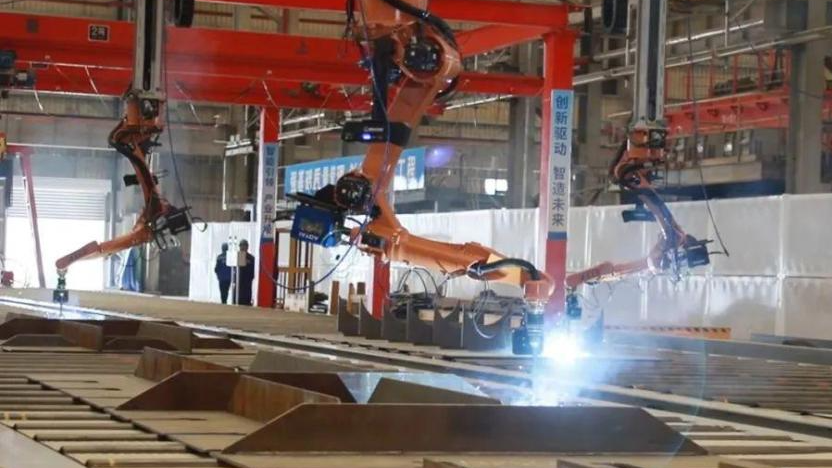
Pipe spools are another good candidate for factory automation. In March 2026, Samsung Heavy Industries started operating PIPE ROBOFAB, a 6,500-square-metre facility linking design, automated logistics, high-precision machining and measurement, fit-up and welding. Samsung gives its design capacity as about 100,000 pipe spools a year.
The value of these lines is not simply replacing one welder. They allow equipment, material and quality data to move to a common rhythm. They also show why automation usually starts with bounded, repeatable operations before moving into the most difficult welds.
Route two: when the structure cannot move, move the robot
As components become large blocks, some welds move inside the structure and the workpiece can no longer be delivered to a fixed station. Yards are therefore deploying lightweight cobots, rail-mounted units and mobile welding platforms that workers can carry, lift or reposition near the joint.
HD Hyundai Robotics’ ArcLift GO and ArcLift SLIDE, shown in 2026, target confined spaces inside ship blocks. ArcPak combines CAD data with 3D structured-light scanning to generate and correct paths from the geometry of the actual part. The objective is to reduce teaching and allow one operator to supervise several machines.
Mobility does not mean full autonomy. Robots may still need to be transported, installed and located by people, while operators set procedures, inspect joints and resolve exceptions. Whether a multi-robot system raises output depends on weld distribution, relocation time, reliability and work organisation, not only the peak speed of one machine.
Erection work in the dock is harder again. Hanwha Ocean recently opened a Smart Automated Welding Center beside the dock for equipment improvement, field testing and welder training. Its roadmap calls for greater mechanisation by 2027, wider automation by 2030 and more intelligent operations by 2035. The centre brings R&D, trials and frontline feedback into one setting; it does not mean those future targets have already been achieved.
Route three: see the real joint, not only the drawing
The as-built condition of a ship component often differs from its digital model. Plate can deform, fit-up positions can move and the gap along one joint may vary. A robot that simply follows a predefined path can miss the seam.
Cameras, structured light, laser scanners, touch sensing and seam tracking are therefore becoming part of the system. They allow a robot to locate the part and joint, then correct its path, torch attitude and selected process parameters. HD Hyundai’s ArcPak and the Tianjin line illustrate two approaches based on CAD plus 3D scanning and multi-sensor fusion respectively.
Hanwha Ocean is also turning the working methods of experienced welders at its Geoje yard into training data. The company’s statement that AI assists 67% of indoor welding should be read as the share of those operations touched by AI and automation, not as proof that 67% is unmanned. People still define procedures, supervise equipment, handle exceptions and control quality.
Even after identifying the joint, a robot must remain stable through arc light, smoke, occlusion and metal spatter. A system that performs well at one station may still need substantial adaptation for a different vessel type, plate thickness, groove or welding process.
Route four: more machines make scheduling the next constraint
As robot numbers rise, the challenge extends beyond individual machines. Which block a component belongs to, which seam comes first, how robots avoid interference, when the part moves onward and how quality data reaches inspectors all depend on links among design, production engineering, planning, logistics and quality systems.
If tasks are still handed over through paper and verbal instructions, robots can lose utilisation while waiting for parts, parameters or inspection. Connecting the design model, work package, machine state, material location and inspection result is what turns automated equipment into continuous capacity. It is also one of the clearest differences between a robot that can weld and a system that understands shipbuilding production.
Humanoids have entered validation, not routine production
Beyond fixed lines and dedicated mobile equipment, shipbuilders are exploring humanoids, mobile dual-arm systems and quadrupeds for passages, ladders, scaffolds and confined spaces designed around human movement.
HD Hyundai signed an initial memorandum with Persona AI and other partners in 2025 and moved into a joint development and commercial-validation phase in March 2026. The work divides responsibilities among training welding systems with shipyard data, integrating the system and developing a bipedal platform able to move stably in a yard. It remains a development, integration and validation programme rather than established production capacity.
Samsung Heavy Industries and Rainbow Robotics are taking another staged route: an AI welding system based on collaborative robots first, followed by mobile dual-arm and quadruped platforms. These forms target different tasks and should not all be grouped under the humanoid label simply because they are mobile or human-like.
Any robot working in a yard must also cope with uneven ground, cable drag, bright arcs, smoke, spatter and maintenance. Continuous uptime, recovery after faults, support staffing and whether real output covers the equipment and integration cost can only be established through production use.
Yards need dependable capacity, not demonstrations
Cumulative weld length is only a starting metric. More useful measures include arc-on time, utilisation, first-pass yield, rework rate, changeover time, operators and maintainers per machine, and cost per metre of accepted weld. Robots add real capacity only when these measures improve together with upstream and downstream processes.
Quality frameworks are adapting as well. China Classification Society’s Guidelines for Welding Inspection of Intelligent Manufacturing of Ships took effect on 1 January 2026. They cover grading of intelligent welding equipment, capability certification, approval of process databases, operational verification and application inspection.
Welding robots are moving from regular shop stations into ship blocks and from fixed paths toward sensing and data-driven operation. No single machine is likely to take over every welding task soon. The investment case will ultimately depend on whether a system can deliver acceptable welds continuously under real conditions and connect smoothly with design, logistics, planning and inspection.