
US Shipbuilding Needs More Than Welders as South Korea Exports a Workforce Training System
Cooperation between Korean shipbuilders and US yards, community colleges and universities is expanding from facilities and orders into instructor development, curricula, registered apprenticeships and naval-architecture education.
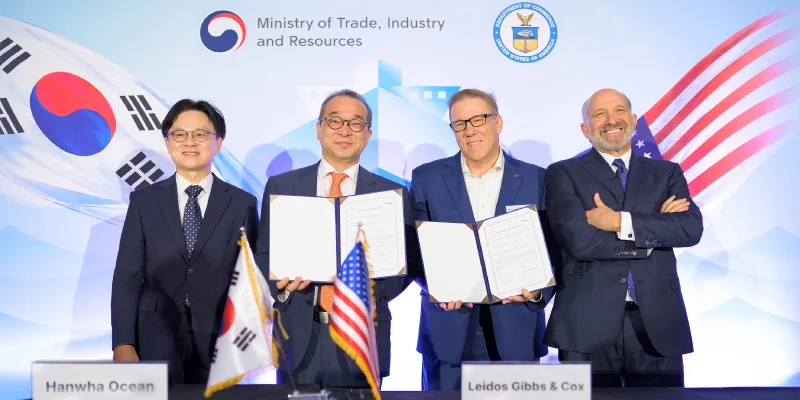
US yards, docks and equipment can be upgraded through investment, and government policy can stimulate orders, but skilled tradespeople and engineers cannot be created quickly. A series of recent partnerships shows US-Korean shipbuilding cooperation moving into a more fundamental area: rebuilding the US training system for shipbuilding talent.
The Cooperation Extends Beyond Front-Line Trades
The two countries opened a Korea-US shipbuilding cooperation centre in Washington on 23 July. Workforce development featured prominently among 15 agreements signed that day. Hanwha Ocean, Hanwha Philly Shipyard and Delaware County Community College will develop shipbuilding-skills training; Samsung Heavy Industries and Vigor Marine plan a maritime training centre in the US Pacific Northwest; and Korean research and industry bodies will work with ABS on technical qualifications, safety training and certification.
Hanwha’s programme covers instructor exchanges, curriculum development, registered apprenticeships and shipyard-based training. Samsung is participating in training-centre development and new teaching technology, while Korean and US universities are collaborating on naval-architecture education. Vocational training, engineering education and shipyard employment are being connected as one system.
Shipyards, Community Colleges and Universities Take Different Routes
Hanwha Philly Shipyard and Delaware County Community College have secured an $8 million, four-year US Department of Labor grant. The programme will send US instructors, apprentices and front-line workers to Korean yards and develop standardised courses for technical schools, community colleges, registered apprenticeships and shipyards. The partners aim to raise annual apprentice capacity from 120 to as many as 500 by 2027.
Samsung Heavy Industries and Vigor Marine plan an advanced maritime training centre in the Pacific Northwest, working together on the facility, curriculum, training technology and later operations. VR and AR welding systems are expected to be included, while the location, initial trades and education provider remain under study.
The target group also includes future engineers. Seoul National University, San Diego State University and HD Hyundai plan to bring 20 to 30 US students and faculty to Korea each year from 2026 for short naval-engineering courses and design experience at HD Hyundai. A separate Samsung-San Diego State advanced maritime centre covers advanced manufacturing, AI, autonomous systems and sustainable maritime technology.
The United States Needs to Rebuild the Wider Talent Base
The US Navy’s annual Maritime Industrial Base report estimates that the shipbuilding and repair supply chain will need about 250,000 additional skilled workers over the next decade: roughly 140,000 for submarine construction and sustainment and 110,000 for surface-ship construction and repair.
South Korea also has practical reasons to export a training system instead of relying on expatriate labour. An OECD report says Korean shipbuilding employment fell 44% between 2014 and 2024. Skilled workers represented only 28% of the workforce in 2023, while foreign workers accounted for about 15%.
Earlier attention centred on Hanwha’s acquisition of Philly Shipyard, yard modernisation and potential orders. Workforce cooperation now includes trades, instructors and engineers. Experienced engineers, managers and skilled workers cannot be recruited and trained quickly; increasing US output depends on rebuilding that human-capital base.