
FPSO Project Cycle Starts to Pay Off, Operator Results Show
Results from SBM Offshore, MODEC and BW Offshore show that the wave of FPSO projects sanctioned in recent years is moving into construction revenue, asset sales, first production and long-term operations.
SBM Offshore reported revenue of $4.904 billion for the first half of 2026 on its management reporting basis, up 112% year on year. EBITDA rose 92% to $1.310 billion, while profit attributable to shareholders increased 201% to $826 million. Its backlog stood at $35.6 billion at the end of June, and the company raised full-year guidance.
The doubling of revenue did not come solely from a larger operating fleet. Turnkey activity grew faster, reflecting the February sale of FPSO ONE GUYANA to ExxonMobil Guyana, the sale of a 45% interest in FSO Chalchi, the effectiveness of contracts for Petrobras’s SEAP I and SEAP II FPSOs, and higher progress on FPSO GranMorgu. Turnkey revenue reached $3.713 billion, up 181% and equal to 76% of group revenue.
SBM Offshore: Asset Sales, Construction and Operations Contribute Together
Lease and operate revenue reached $1.191 billion, up 21%, with segment EBITDA rising 10% to $547 million. SBM Offshore currently operates 16 offshore floating facilities, which processed more than two million barrels of oil equivalent per day on average in June 2026.
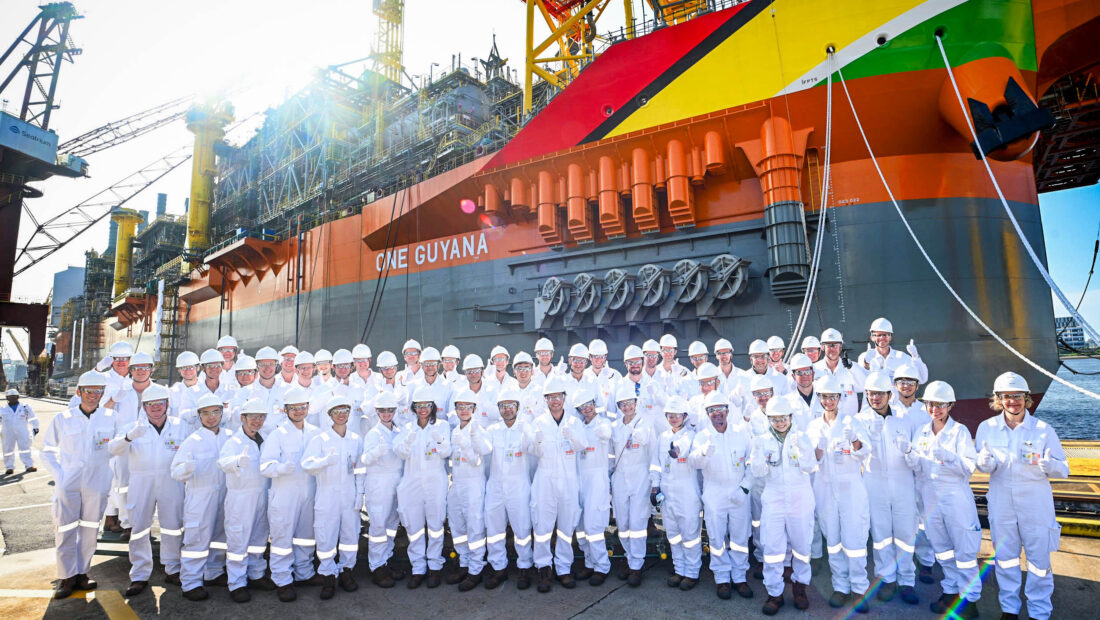
FPSO ONE GUYANA was one of the clearest drivers of first-half growth. Completed in 2025, the vessel was formally acquired by ExxonMobil Guyana in February 2026. The sale generated a large turnkey contribution, while SBM Offshore continues to provide operations and maintenance after the unit entered production.
GranMorgu is contributing during construction. Revenue is recognised as engineering, procurement and fabrication advance. Jaguar’s topsides construction is nearing completion and its rate of revenue growth is slowing, while Almirante Tamandaré, Alexandre de Gusmão and ONE GUYANA moved beyond peak construction revenue after completion in 2025.
The pipeline continues to expand. During the first half, SBM Offshore secured the SEAP I and SEAP II contracts, began FEED for ExxonMobil’s Longtail development in Guyana and ordered its thirteenth Fast4Ward multipurpose hull. The $35.6 billion backlog combines current project execution with lease and operating income extending over many years.
MODEC: EPCI Growth and New O&M Revenue
MODEC reported first-quarter revenue of $1.077 billion, up 23% from $873 million a year earlier. Adjusted EBITDA increased about 59% to $128 million, and net profit rose 80% to $99 million.
On the engineering side, Gato do Mato and Hammerhead moved into their second year of construction, lifting recognised EPCI revenue. Uaru and Raia moved closer to completion and Bacalhau had finished, reducing their engineering contribution. In O&M, the existing fleet remained stable while Bacalhau and Uaru added new revenue. EPCI revenue increased by $129 million year on year and O&M revenue by $83 million.
Gato do Mato carries a 20-year O&M contract and Hammerhead a 10-year contract. MODEC’s remaining average O&M contract term is 14.2 years. Delivery does not remove an FPSO from the operator’s earnings base; it changes the revenue stream from construction to long-term operations.
Project Maturity Does Not Lift Every Operator at the Same Rate
BW Offshore illustrates why project maturity does not produce the same profit surge for every company. First-quarter 2026 EBITDA was $47.9 million, broadly flat quarter on quarter, and net profit was $23.4 million. A temporary shutdown during BW Opal commissioning led the company to lower full-year EBITDA guidance, while an amended BW Catcher contract added about $490 million of firm operating cash-flow backlog.
SBM Offshore is realising value through the sale of ONE GUYANA, construction of GranMorgu and its operating fleet. MODEC is growing EPCI revenue through Gato do Mato and Hammerhead while Bacalhau and Uaru add O&M income. BW Offshore is balancing BW Opal commissioning, an extended BW Catcher contract and new project development.
The Market Is Moving from Sanctioning into Delivery and Operations
In recent years, FPSO headlines were dominated by FID, FEED, EPCI awards, steel cutting and module fabrication. Now ONE GUYANA has been sold and entered production, Agogo has completed its first year onstream, Bacalhau and Uaru are contributing operating revenue, and BW Opal has started gas production. GranMorgu, Jaguar, Gato do Mato and Hammerhead continue towards delivery.
FPSO construction usually takes several years, while operations can last 15 to 20 years or more. A yard’s main construction role winds down at delivery; for an FPSO provider, long-term lease, O&M and asset-management income starts after production begins.
The next wave is already forming. SBM Offshore has SEAP I and SEAP II and is performing Longtail FEED. MODEC is advancing Gato do Mato, Hammerhead, Raia and Uaru. BW Offshore is participating in Bay du Nord FEED and continues to evaluate opportunities in Brazil and Mexico.
For Chinese shipbuilding and offshore companies, this shift does not signal an imminent decline in fabrication demand. Multiple FPSOs remain in design or construction for Guyana, Brazil and Suriname, supporting continued demand for hulls, topsides modules, equipment and integration work.