
What Can Offshore Contractors Do When the Oil and Gas Cycle Turns?
Offshore wind, floating data centres, industrial modules and CCS can broaden the market, but resilience depends on repeat customers, transferable capabilities and early preparation.
After oil prices fell in 2014, offshore developments were delayed worldwide, demand for rigs and offshore equipment contracted, and some yards endured a prolonged downturn. FPSOs, FLNG facilities and deepwater projects have since rebuilt many order books, but the cyclicality of upstream investment has not disappeared.
Offshore wind is already familiar territory for Chinese offshore contractors. New engineering demand is also emerging in data centres, large industrial modules, and carbon capture and storage. Some opportunities have produced firm orders; others remain at the technology-development stage. Whether they become durable businesses will depend on how well existing capabilities transfer and whether companies prepare their technology, people and customer relationships before the next downturn.
1. Offshore power is already a mature non-oil business
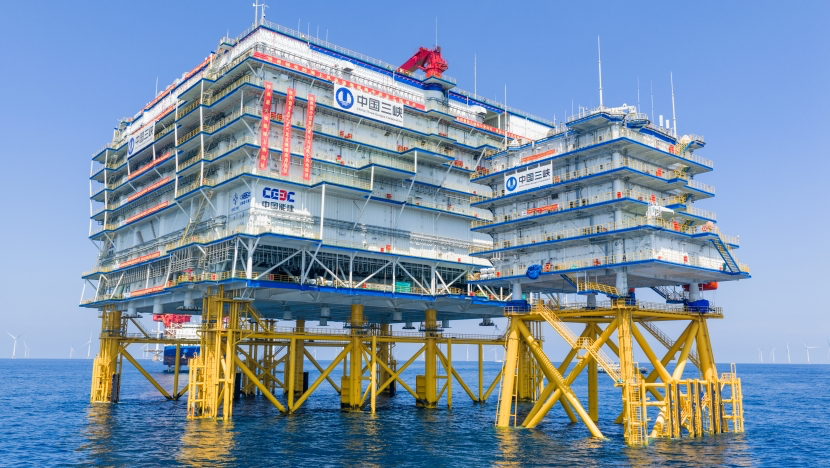
Chinese yards and offshore contractors have participated in offshore wind for years, building foundations, substations, converter platforms and installation vessels. In June 2026, the 25,000-tonne topside of the Haifengzhixin converter platform for the Yangjiang Qingzhou 5 and 7 wind farms was installed by float-over. The project directly applied established offshore capabilities in heavy fabrication, systems integration, marine transportation and installation.
Seatrium’s 2025 results show how meaningful this market can become. Its net order book was about S$17.84 billion at year-end, with offshore wind representing 33% and oil and gas 66%. Oil and gas remained dominant, but grid operators and offshore-wind developers already accounted for a substantial share of the workload.
Grid operators and wind developers typically define the requirement, specialist vendors supply the core electrical equipment, and offshore contractors deliver large structures, module integration, transportation, installation or EPC scopes. For companies with heavy fabrication and offshore-construction capacity, this is an established route beyond oil and gas.
2. Floating data centres bring shipyards into digital infrastructure
Rapid data-centre growth is tightening access to power, land and cooling in some markets. Coastal terminals, ports and nearshore waters are therefore attracting attention, and shipyards are beginning to develop floating concepts.
In July 2026, Bureau Veritas granted approval in principle to Seatrium’s 30 MW concept: a jetty-moored, non-propelled barge with six independent 5 MW modules integrating IT equipment, cooling and power distribution. In September, ABS granted AiP to Hanwha Ocean’s 60 MW concept. Both remain design-validation projects; no commercial construction contract has been announced.
China is pursuing a different route. A 2.3 MW first-phase subsea data-centre demonstration powered directly by offshore wind entered operation in Shanghai’s Lingang area in 2026, with 24 MW planned across two phases. Subsea deployment presents different structural, construction and maintenance challenges from a barge-based facility.
Floating data centres can draw on naval architecture, stability, mooring, corrosion protection and large-module integration. But they also demand power reliability, cooling performance and maintainability beyond conventional offshore assets. Short server replacement cycles and the cost of offshore maintenance must be designed into the operating model.
Power supply and whole-life economics will determine commercial viability. Shore power depends on grid capacity and connection cost; independent generation introduces fuel, efficiency, emissions and redundancy questions. Seawater cooling can reduce energy use, but hull, mooring and offshore maintenance add costs. A floating solution must therefore offer a compelling advantage in land availability, grid access or delivery time.
Before commercial orders arrive, yards can contribute to hull design, module layout, interfaces and maintenance planning while building relationships with data-centre operators and equipment suppliers. The ability of early concepts to become repeat orders will depend on project-level economics.
3. Large industrial modules can take offshore yards into onshore markets
Offshore contractors have long built FPSO topsides, FLNG liquefaction modules and other process facilities. Equipment, piping, electrical and instrumentation systems are assembled and tested in the yard, then shipped for hook-up and commissioning. The same delivery method can suit onshore projects where site labour is expensive, construction conditions are difficult, or very large plants must travel by sea.
Chinese offshore companies are testing new applications. In June 2026, BOMESC management disclosed that the company had accepted an overseas order for modular skids used in lithium-battery recycling. Existing facilities were used for fabrication while technical teams studied the process, creating a practical extension beyond FPSO and LNG modules.
New-fuels projects are also adopting modular execution. Technip Energies’ first-half 2026 results said the Ecoplanta waste-to-methanol project had placed a modularisation-yard subcontract and major equipment orders for delivery to the yard. Such process modules create openings for fabricators with relevant experience.
Nuclear developers are drawing on the same expertise. In April 2026, Rolls-Royce SMR selected Aker Solutions as its primary module partner and announced a memorandum of understanding. Around 80% of the plant is conventional non-nuclear scope, allowing modular-delivery experience from oil and gas to enter the SMR supply chain. The collaboration is still at the development stage.
These markets are not reserved for offshore companies. Worley completed FEED for the UK Lighthouse Green Fuels sustainable-aviation-fuel project in June 2026. In the same month, Chengda completed intermediate handover of the first 50,000-tonne-per-year green-ammonia unit at China Energy’s Green Hydrogen City project. Wison Engineering and Sungrow Hydrogen had earlier introduced the MegaFlex modular green-hydrogen plant concept.
Established EPC contractors have process-design, procurement and delivery capabilities, and some are developing standardised modular solutions. Offshore yards will both compete with and partner these firms.
China’s coastal offshore bases offer large fabrication areas, deepwater quays, heavy lifting and experienced piping, electrical and instrumentation teams. Their advantage is strongest for large, heavy, sea-transportable modules. Yet process technology, module breakdown, equipment selection and performance requirements are often fixed during early engineering.
Companies with engineering and systems-integration capabilities can engage during FEED and modularisation studies. Fabrication-led yards can enter the supply chains of EPC contractors and target clearly bounded scopes matched to their strengths.
As modular delivery spreads, traditional industry boundaries will matter less. Offshore yards can serve onshore projects, while industrial EPC companies can expand into large-scale modular fabrication. The winners will still be determined by technology, cost, references and execution.
4. Carbon capture and storage is creating new subsea demand
On 8 October 2026, Eni announced installation of the Douglas CCS platform for the UK Liverpool Bay project. Its 1,885-tonne topside and 1,755-tonne jacket will receive captured CO₂ from industrial sites in northwest England and north Wales, before the gas is transported through repurposed offshore pipelines to depleted reservoirs for permanent storage.
The project has already generated conventional offshore work. In April 2025, Rosetti Marino won an EPC contract worth more than €300 million covering four new and modified platforms, including engineering, procurement, fabrication, load-out, offshore hook-up and commissioning.
Norway’s Northern Lights project demonstrates a service-based model. In March 2025, Equinor, Shell and TotalEnergies took the final investment decision on Phase 2, investing about NOK7.5 billion to expand annual transport and storage capacity from 1.5 million tonnes to at least 5 million tonnes. A 15-year agreement with Stockholm Exergi for up to 900,000 tonnes a year helped underpin the expansion. Northern Lights completed its first CO₂ injection in August 2025.
Subsea7 won the Phase 2 subsea contract in March 2025. Its scope covers EPCI of approximately five kilometres of CO₂ pipeline, plus satellite structures, umbilicals, tie-ins and pre-commissioning. Subsea7 classifies the award at US$50-150 million.
CCS requires platforms, subsea pipelines, transport ships, connection systems and injection equipment that overlap with conventional offshore work. Liverpool Bay also involves modification and life extension of existing infrastructure. Yet CO₂ phase behaviour, materials, corrosion, injection pressure and long-term containment require specialist competence beyond a straightforward transfer of oil-and-gas experience.
The investors may still be energy majors, but end customers now include cement, waste-to-energy and chemical producers. Project demand is driven by industrial decarbonisation, long-term transport and storage contracts, and public policy, rather than only new upstream investment.
For offshore contractors, CCS can create newbuild, brownfield modification, subsea installation and long-term maintenance work. The market remains dependent on policy support and bankable contracts, but Liverpool Bay and Northern Lights show that industrial emissions reduction is already turning into marine engineering demand.
5. Can new businesses really replace an oil-and-gas order gap?
Announced investment does not automatically become yard work. The IEA’s Global Hydrogen Review 2026 puts announced low-emissions hydrogen capacity for 2030 at about 27 million tonnes a year, while projects already operating, under construction or at final investment decision correspond to only about 4.3 million tonnes. For offshore contractors, investable projects and signed construction scopes matter more than headline pipelines.
Even a signed order may use a different part of the industrial base. FPSO hulls consume block-fabrication and dock capacity; converter platforms and industrial modules rely more on module yards, heavy lifting, piping, electrical work and commissioning. Similar contract values can translate into very different workloads.
Revenue is not the same as self-performed value. Large EPC contracts include purchased equipment, specialist subcontracting and transport. Entering an unfamiliar sector also adds interface, code and performance-guarantee risk. If orders are sporadic, early technology and business-development costs are difficult to amortise.
Renewables, power and industrial infrastructure have their own investment cycles. Financing conditions and policy changes can affect several markets at once, so other sectors may not peak exactly when upstream spending falls.
Diversification is therefore not a count of new sectors. Its value lies in building a small number of businesses that generate repeat orders, use existing resources effectively and contribute stable margins and cash flow.
6. Technology, talent and customers must be prepared early
During a strong upstream cycle, engineering resources are absorbed by live projects. When orders weaken, companies often cut costs and headcount. But technology, specialists, vendor qualification and customer relationships for new markets cannot be created overnight.
The required preparation depends on the target market. Beyond structural, mechanical, piping and electrical disciplines, teams must understand new process technology, equipment standards, interfaces and acceptance requirements. For industrial modules, module breakdown, layout, transport and installation decisions are often made during FEED; early participation improves the chance of winning later design, fabrication and integration work.
Much of the capability can be developed from existing teams. Engineers, quality staff and project managers already understand complex delivery. Targeted hires and partnerships with technology owners or equipment suppliers are often more practical than rebuilding an entire capability stack.
Different contractors should prepare differently. Design houses and EPC companies can enter concept development, FEED and modularisation. Large yards can focus on fabrication and integration matched to their sites and marine access. Subsea and installation contractors can target CCS, cables and brownfield modifications.
New offshore applications are also reaching operation. In July 2026, the Dutch PosHYdon pilot produced green hydrogen on the existing Q13a-A North Sea platform, combining offshore wind power, seawater treatment and electrolysis. In 2025, Bahri brought all three floating desalination barges into commercial operation under a 20-year offtake agreement; together they can produce 150,000 cubic metres of freshwater a day.
Integrated offshore-energy platforms, floating utilities and repurposed oil-and-gas infrastructure could create further design, fabrication and systems-integration demand. Offshore companies can develop solutions with power, water-treatment and technology specialists, but scaling will still depend on real demand, capital cost and operating economics.
Market development also has to start earlier. Rather than immediately bidding for full EPC scope, an entrant can join modularisation studies, co-develop a technical solution or take a well-defined fabrication subcontract. This builds references and qualification with owners and EPC contractors.
Preparation does not require an immediate new factory or large hiring programme. Research, training, customer engagement and joint concept work can progress in stages. A company can test one or two adjacent markets through smaller projects before committing more capital.
Today’s relatively strong upstream order books provide cash flow and a base of experienced people. Using this period to build capabilities, relationships and references is more effective than searching for alternatives after the cycle turns.
7. The next downturn may widen the gap between contractors
The sector is likely to diverge further. Some specialists will remain focused on FPSOs, FLNG and selected offshore-construction niches. Others will use the same engineering base to serve power, industrial modules, digital infrastructure and decarbonisation. Different customer and order mixes will create different resilience when upstream investment contracts again.
Oil and gas is likely to remain a major foundation of offshore engineering over the next decade, but its cycle need not determine every company’s fate. Some offshore contractors can evolve into broader engineering businesses serving energy, power, digital infrastructure and heavy industry.
By the next downturn, one company may already have repeat customers and continuous work from several industries, while another is only beginning to rebuild skills and sales channels. That difference is being created during today’s strong market.